How to light a garage or workshop
Updated 9 September 2026 · 7 min read
Light a garage in two layers: an even ceiling layer, and a movable light you can put where you are actually looking. Size the ceiling layer at roughly 300 lumens per square metre of floor, choose 5000–6500K daylight rather than warm white over a workspace, and check the IP rating on anything that will meet damp or spray.
Work out the lumens, not the watts
Wattage stopped describing brightness the moment LEDs arrived: it tells you what a fitting costs to run, not what it puts out. The number that matters is lumens, the total light a fitting emits. The useful version of it is lux, which is simply lumens spread over a square metre of floor — one lux is one lumen per square metre, and that is the whole of the arithmetic.
As a rule of thumb, a garage used for general work wants somewhere around 300 lumens per square metre, and a bench or a bay where you are looking closely at something wants nearer 500. Those are guides rather than rules, and they assume the light is spread out: the same total from one fitting in the middle of the ceiling does not do the same job.
Treat the lumen figure on a marketplace listing with some suspicion, particularly a round number with no test behind it. Where two fittings claim the same output and one is half the price and half the weight, the difference is usually in the claim rather than in the light.
- 1Measure the floorLength times width. A common UK single garage is roughly 3m by 6m, so about 18 square metres.
- 2Pick a targetAround 300 lumens per square metre for general use; nearer 500 if the space is a workshop rather than somewhere the car sleeps.
- 3Multiply it out18 square metres at 300 is about 5,400 lumens for the room. That is the total across every ceiling fitting, not the rating of one of them.
- 4Spread it outSplit the total across several fittings or a linked array. Even coverage removes shadows; one very bright point only moves them.
- 5Add a light you can moveWhatever the ceiling does, keep one source you can put where you are looking. It is the only thing that solves working in your own shadow.
Colour temperature: warm, neutral or daylight
Colour temperature is measured in kelvin and describes the colour of the light, not how much of it there is. A 6500K fitting is not brighter than a 2700K one, it is whiter. Over a bench that matters, because true colour is how you spot a paint defect, a hairline crack, or which of two blue wires is the darker one.
| Colour temperature | What it looks like | Where it belongs |
|---|---|---|
| 2700K | Warm yellow, like an old filament bulb | A bar corner, seating, anywhere you sit down |
| 4000K | Neutral white | A garage that doubles as a room; hallways and stores |
| 5000–6500K | Daylight, faintly blue-white | Benches, bays, and any job where colour has to read true |
One fitting overhead lights the room, not the job
A single light in the centre of a ceiling puts you between the source and the work, so the shadow you are trying to see into is your own. Brightness does not fix that geometry — a brighter bulb behind you casts a harder shadow in front of you. The fix is a second source at a different angle.
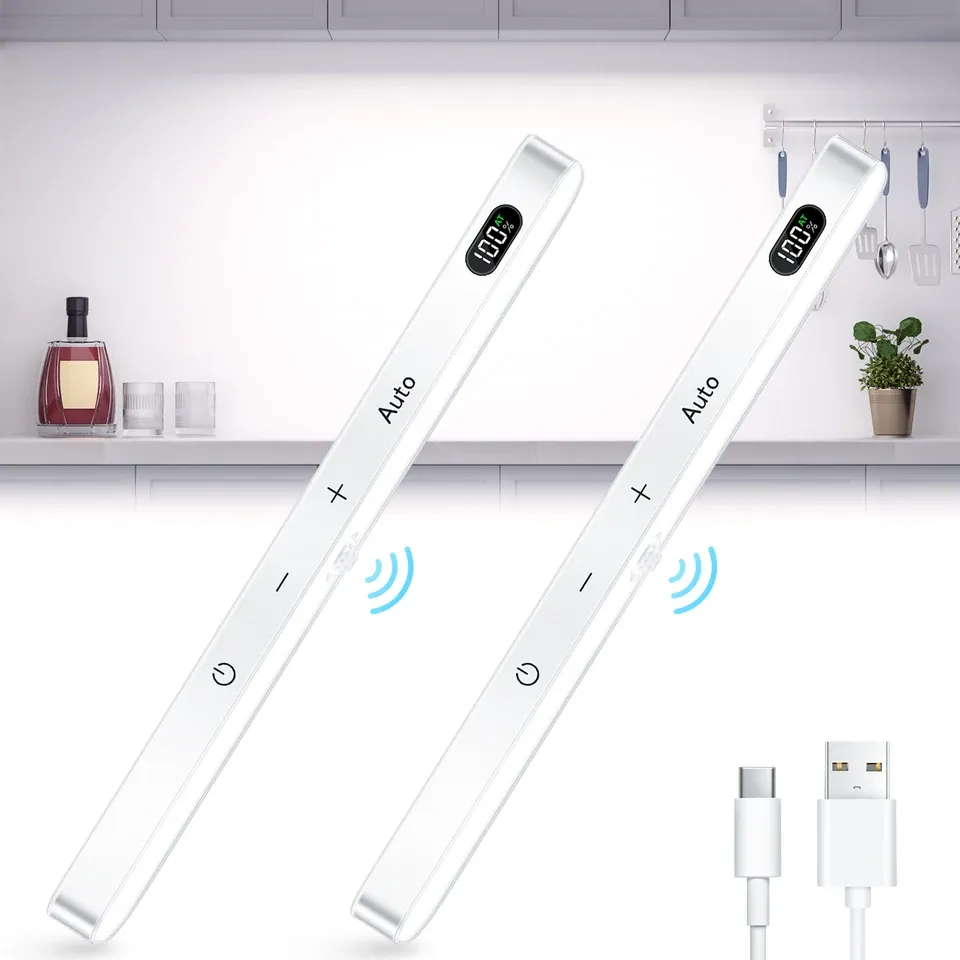
That second source usually wants to be movable. A magnetic light sticks to a wing, a bulkhead or a bench leg and goes where the job is; a light bar under a shelf or inside a cupboard lights the place you are reaching into rather than the room you are standing in. Between them they cover most of what a ceiling cannot.
A motion sensor is worth having on anything inside a cupboard or behind a door, for the plain reason that both hands are usually full at the moment you want it on.
Mains or rechargeable
These solve different problems and most garages want both. Mains fittings are permanent, on when you want them and never flat. Rechargeable lights go where no cable runs and cost nothing to install, and the honest price of that is that charging them becomes your job — put them back on the lead every few months rather than finding out on the night.
Within mains there is a real difference between screwing something into the lampholder that is already there and wiring in a new fitting. A fold-out panel lamp is the cheapest genuine improvement most garages can have and it is a five-minute job with the power off. Check the cap first: plenty of UK holders are bayonet rather than screw, and a US E26 lamp is not the same fitting as a UK E27 one.
A hard-wired ceiling array is a different matter. If electrical work is not something you are competent and qualified to do, it is an electrician's morning rather than a Saturday afternoon.
IP ratings, and when they matter
An IP rating is two digits. The first is protection against solid objects and dust, the second against water, and in both cases a higher number is more protected. An X in place of a digit means that side was not tested, rather than that it failed.
| Rating | Solids | Water | What that suits |
|---|---|---|---|
| IP20 | Fingers and large objects | None | Dry indoor fittings, clear of splashes |
| IP44 | Objects over 1mm | Splashing from any direction | A dry garage ceiling; a covered light outside |
| IP65 | Dust-tight | Low-pressure jets | Dusty workshops, damp garages, anything near an open door |
| IP66 | Dust-tight | Powerful jets | Work lights taken under a car, wash bays, anything hosed down |
Where the rating actually earns its money
Most garages are dry enough that a ceiling fitting needs nothing special. The rating pays for itself on the light you take to the work: a hand light that goes under a car, into a wheel arch or out onto the drive in the rain is the one that meets water, dust and grit.
If a product quotes no rating at all, that is not a rating of zero — it means the maker has not published one, and it should be treated as a dry indoor fitting until they do. That is worth knowing rather than guessing at, because an unrated light in a wet bay is the one that fails first.
Common questions
- How many lumens do I need to light a garage?
- As a rule of thumb, around 300 lumens per square metre of floor. A single garage of roughly 18 square metres therefore wants about 5,400 lumens in total, spread across several fittings rather than concentrated in one. Aim nearer 500 per square metre over a bench you work at closely.
- Is 6500K too bright for a garage?
- 6500K is a colour rather than a brightness — it describes daylight-white light, not how much of it there is. Over a bench or a bay it is the right choice, because colours read true. In a seating or bar corner it feels clinical, and warm white nearer 2700K suits that end of the room better.
- What IP rating do I need for garage lighting?
- A ceiling fitting in a dry garage needs nothing special, and IP20 or IP44 is normal. The rating matters on lights that go to the work — under a car, into an arch, outside on the drive — where IP65 or IP66 means dust and water are not what ends its life. No quoted rating means none has been published, so treat it as indoor and dry.
- Can I install garage lighting myself?
- A lamp that screws into the lampholder already there is a five-minute job with the power off, and a rechargeable magnetic light needs no installation at all. A hard-wired ceiling fitting is different: unless electrical work is something you are competent and qualified to do, it is a job for an electrician.